Saturday, November 05, 2011

对大千新手们的忠告(ZT)

对大千新手们的忠告。

来源: 比灵通2011-10-27 19:27:49

要想作好股票,并且能够稳定地常年盈利:

1: 必须摒弃去看任何新闻的习惯。那是mm用来骗散户的工具。

2: 尽量不要碰个股,中概,垃圾(小于10美元的股票),小盘子交易量股票,不能碰。

3: 必须形成自己严格的交易系统,俺用的是MACD, SLow stoch,加上很多年被摧残的经验。

4: 不做空,看错了,及时止损,哪怕割肉在最低点。(俺做空即使做对,也赚不到大钱)

5: 年底的时候,可以稍微大胆一点。年一过,不要有任何幻想,只能做大盘的DIA, SPY, QQQ.其它都不靠谱。

6: 买卖option是条破产最快的捷径,即使你每次都看对。

有两本书建议有时间看一看,很有帮助: 1:Stock trader's almanac

2: How to make money in the stock market.

3: Livermore 的回忆录。

这几本书,俺读了不下5遍。非常有帮助。Livermore 说:投机就象山岳一样古老,华尔街从来就没有任何新东西。

与大千新手们共勉

Saturday, September 03, 2011

Fix a calling away covered Call

I bought Sept $41 SLV covered call, and SLV is over 42.5 in mid August, it is a sure winning trade, but I don't want my SLV be called away.

When a covered call is going to be called away, should you adjust it? Well, I find out the answer is like playing black Jack, you don't want to split your 20 points winning hand.

I bought another $44 covered call at $40.7 on August 23, and I adjusted the price by $1 to Sept $42 SLV covered call for $0.37 on Sept 1st, it looks great now as SLV is over $42 again.

Remember every end of month future clearing dates are good dates for buying SLV. Here is the list of dates:

NYMEX gold and silver options expire on the fourth business day prior to the future contract’s delivery month. The settlement type of the option is the physical metal underlying the futures contract. Delivery may take place on any business day beginning on the first business day of the delivery month or any subsequent business day of the delivery month, but not later than the last business day of the current delivery month.

2011 gold and silver options expiration calendar:

12 December 2010
26 January 2011
23 February 2011
28 March 2011
26 April 2011
25 May 2011
27 June 2011
26 July 2011
25 August 2011
27 September 2011
26 October 2011
22 November 2011

Wednesday, April 20, 2011

What To Do When Your Options Trade Goes Awry

What To Do When Your Options Trade Goes Awry

by John Summa,CTA, PhD, Founder of OptionsNerd.com and HedgeMyOptions.com

Successful optionstradingis not about being correct most the time, but about being a good repair mechanic. When things go wrong, as they often do, you need the proper tools and techniques to get your strategy back on the profit track. Here we demonstrate some basic repair strategies aimed at increasing profit potential on a longcallposition that has experienced a quickunrealized loss.

Defense Is Just as Important as Offense
Repair strategies are an integral part of any trading plan. I always review a well thought-out set of "what-if" scenarios before putting any money atrisk. Too often, though, beginner options traders give little thought to potential follow-up adjustments or possible repair strategies before establishing positions. Having a great strategy is important, but making a profit is highly correlated with how
well losing trades are managed. "Play good defense" is my options-trading mantra.

Fixing a Long Call

Many traders will buy asimplecall or putonly to find that they were wrong about the expected movement of the underlyingstock. An out-of-the-moneylong call position, for example, would experience immediate unrealized losses should the stock drop. What should the trader do in this situation?

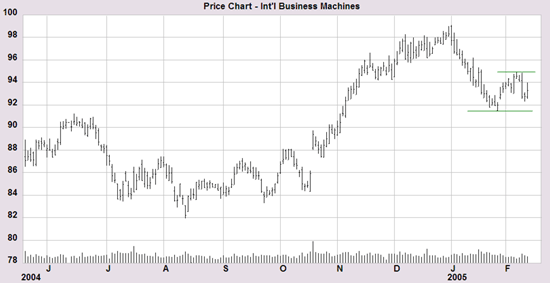
Let's examine a simple long call example, which demonstrates a concept that you can apply also to a long put. Suppose it is currently the middle of February and we believe that IBM, which at 93.30, is poised to make a move above resistance(the upper green line in Figure 1) at about 95. We have good reason to jump in early with the purchase of a July 95 near-the-money call. With about 150 calendar days left untilexpiration, there is plenty of time for the move to occur.

Figure 1 – IBM daily price chart showing medium support/resistance levels.


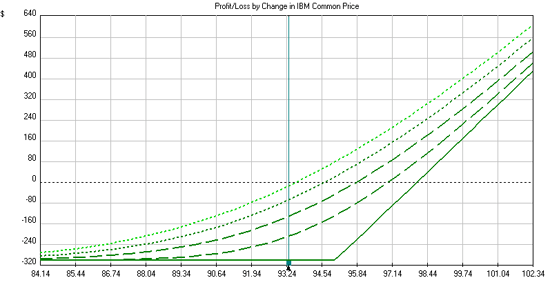
But suppose, not long after we enter the position, IBM gets a downgrade and drops suddenly, perhaps even below medium-term supportat 91.60 (the lower green line in Figure 1) to about 89.34. The price of the July 95 call would now be worth about $1.25 (assuming sometime-value decay), down from $3, rendering an unrealized loss of $175 per option. Figure 2 presents the profit/loss profile of this trade.

Figure 2 – IBM July 95 long call profit/loss.


With so much time remaining until expiration, however, it's still possible that IBM may reach and surpass the strike priceof 95 by Jul 16, but waiting could add additional losses and present additionalopportunity costs, which result from our forgoing any other trade with profit potential during the same period.

Initial IBM Price July 95 Call Purchase Price Lower IBM Price Lower July 95 Call Price July 90 Call Price
93.30 $3.00 89.30 $1.25 $2.75
Table 1 – Options prices before and after IBM price change.


One way to address unrealized loss is to average downby purchasing more options, but this only increases risk should IBM keep falling or never return to the price of 95. Actually, the breakeven on the original July 95 call, which was purchased for $3, is 98. This means that the stock would have to rise by nearly 10% to get to the breakeven point. Averaging down by purchasing a second option with a lower strike price, such as the July 90 call, lowers the breakeven point, but adds considerable additional risk, especially since the price has broken below a key support level of 91.60 (indicated in Figure 1).

One simple method to lower the breakeven point and increase the probability of making a profit without increasing risk too much is to roll the position downinto abull call spread. This is a strategy presented by options educator, Larry McMillan, in his book, "Options as a StrategicInvestment", a must-have standard reference on options trading.

To implement this method we would place an order to sell two of the July 95 calls at the new price of $1.25, which amounts to going shortthe July 95 call option since we are long one option already (selling two when we are long one, leaves us short one). At the same time, we would buy a July 90 call, selling for about 2.90. Table 2 presents the price details:

Transactions Debits/Credits Cumulative Net Debits/Credits
Buy July 95 call -$300 -$300
Sell 2 July 95 calls +$250 -$50
Buy 1 July 90 call -$275 -$325
Table 2 – Transaction details of rolling down into a bull call spread


The net result of this adjustment into a bull call spread is that our total risk has increased only slightly, from $300 to $325 (not counting commissions). But our breakeven point has been lowered considerably from 98 to 93.25, a drop of 4.75%.

Suppose now that IBM manages to trade higher, back to the starting point of 93.30. Our bull call spread would now be just above breakeven, with a potential profit as high as 95, although limited to just $175 per option. We have, therefore, lowered our breakeven point without adding much additional risk, which makes good sense.

Alternative Repair Approach

Another repair attempt (which can perhaps be combined with the one above) is to roll down into a butterfly spreadwhen IBM falls to 90. With this strategy we sell two July 90 calls, which would be going for about $4 each, and keep the July 95 long call, and then buy a July 85 call for about $7.30 (assuming a little bit of time-value decay in these numbers).

Transactions Debits/Credits Cumulative Net Debits/Credits
Buy July 95 Call -$300 -$300
Sell 2 July 90 Calls +$800 +$500
Buy 1 July 85 Call -$730 -$230
Table 3 – Transaction details for roll to a butterfly spread.


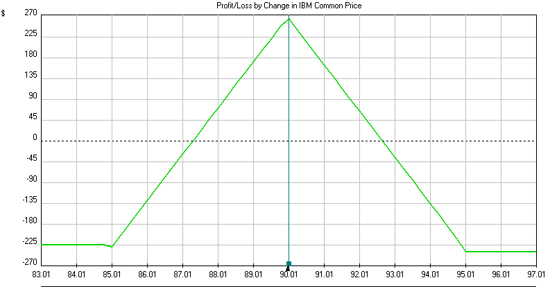
The total risk actually decreases on the downside since the total debits fall to $230, but there is some limited upside risk should IBM move back above 92.65 (breakeven). If IBM goes nowhere, however, the trade actually produces a nice profit, occurring between 87.30 and 92.65. The profit/loss table below presents our different scenarios for this repair strategy:

IBM Price At Expiration Profit/Loss
85.00 -$225
87.30 Breakeven
90.00 +$264
92.65 Breakeven
95.00 -$235
100.0 -$235
Table 3 – Profit/loss details for butterfly spread repair strategy.


Meanwhile, maximum potential losses are $235 (upside) and $225 (downside). Maximum potential profit is at 90 with $264, and profit decreases marginally as you move toward the upper and lower breakeven points, as seen in Figure 3.

Figure 3 – Butterfly Profit/Loss Profile


Combining the Repair Strategies

Since this is a butterfly spread, maximum profit by definition is at the strike of the two short calls (July 90 calls), but movement away from this point eventually leads to losses. Therefore, the best overall approach might be to mix our two repair strategies in a multi-lot repair approach. This combination can preserve the best odds of producing a profit from a potential loser: the bull call-spread repair has a profit from 93.25 up to 95. And, there are ways to adjust a butterfly spread given moves of the underlying (a topic that would require a separate article).

The Bottom Line
We've looked at two ways (which might best be combined) to adjust a long call position gone awry. The first involves rolling down into a bull call spread, which significantly lowers overhead breakeven while preserving reasonable profit potential (albeit this potential is limited, not unlimited as in the original position). The cost poses only a tiny increase in risk. The second approach is to roll into a butterfly spread by keeping our original July call, selling two at-the-moneycall options and buying an in-the-moneycall option. Whether used alone or in tandem, these repair strategies offer some flexibility in your trading plans.

There will always be losses inoptions trading, so each trade must be evaluated in light of changing market conditions, risk tolerance and desired objectives. That said, by properly managing the potential losers with smart repair strategies, you stand a better chance of winning at the options game in the long run.

Tuesday, April 19, 2011

Options Risk and Manipulation

Options Risk and Manipulation [引用]
From Vince Lanzi of FMX Connect

Options Risk, Manipulation, and the May Silver $40 Calls

The purpose of this series is to help the reader better understand the risks and pitfalls of trading options and having a position at expiration. We will try to describe exactly what happens at expiration. The concepts here apply to all options markets, but we chose to focus on Silver because an interesting expiration is setting up presently. The upcoming expiry gives us an opportunity to discuss all the pieces of the option puzzle: the Greeks, market manipulation, Pin risk, and other factors.

Lesson #1

In futures markets where major participants are absent, options players dictate market movement for short periods of time. During this time the market may flat line, or it may have large, impulsive moves in either direction. What happens is determined by the strong-handed player, and sometimes his inclination to “game” the market.


The Easter Egg

Observe if you will, the 6 days prior to expiration of Comex May Silver options.


April 21st, Holy Thursday: day before a holiday

April 22nd: Good Friday: CME Closed

April 23rd,Easter Saturday: Markets Closed

April 24th,Easter Sunday: Markets Closed

April 25th, Easter Monday: LME Closed (Largest Physical Bullion Exchange Worldwide)

April 26th, Tuesday: May Options Expiration CME


One may ask, what does the above imply? The above implies that normal liquidity will not be present for the last 5 days before expiration. Sunday Evening US time is usually quite liquid during London hours, but will not be this week. Monday will also be a liquidity ghost town, as LME players will be out. It is doubtful that many US futures liquidity providers will be in the day after Easter either. This is a market ripe for an event.


Throughout this week and next, we will attempt to break down the factors influencing the outcome of this expiration as a proxy for understanding commodity options risk in general. It will include:

· The players and their biases

· Option Greeks demystified

· How to spot when a market is ripe for “management”, like above.

· Regulatory factors enabling this behavior.


Part 2: A Zero-Sum Game

In any single trade, the option buyer and seller are fundamentally at odds. Both types of player (referred to as options long and options short) make their money in opposite ways, and at the expense of the other. The long players expect to make more money scalping Gamma than they lose in Theta over the option’s life. The Short players bet that the Theta they collect will outweigh the market movement and the negative Gamma they incur, most poetically described as “wishing for death”.

To understand how and why markets sometimes get “managed” at expiration it would make sense to first understand the Option Greeks. This combined with who the players actually are, and understanding the regulatory inconsistencies will tell the full tale on why markets are ripe for manipulation near options expiration.


Keeping Score

Managing Options risk is a complex task. We are going to focus here on only three of the “Greeks” used to quantify and manage risk, Delta, Gamma, and Theta. These are the most important ones affecting an option trader’s behavior as expiration approaches and the market is hovering near a strike. We’ll attempt to explain them plainly and simply through examples. For these explanations we must assume that all other Greek parameters: like volatility, rho, etc remain static to better isolate the effects of delta, gamma, and theta on risk.


Delta

In physics Delta means rate of change. In calculus Delta is the tangent of the trajectory. But Delta actually has 3 definitions in the practical trading world. These definitions largely overlap but are not necessarily the same for the whole life of the option.

1. Correlation with the underlying: a Call has a 20 delta. The model generating that delta assumes the Call’s value will change by 20% of what the underlying changes. E.g. Crude Oil goes up by $1.00. The Call will go up by $0.20 assuming other Greeks remain the same.

2. Hedge Ratio: The long 20 delta call would be directionally neutralized if it had a hedge of short 0.20 futures per long options contract. E.g. I am long 100 Crude Oil calls with a 20 delta. I will sell 20 futures to hedge myself directionally. Therefore I will (theoretically) neither make nor lose money in either direction due to underlying movement. I am directionally “flat”

3. Probability of Expiring in-the-money: according to the model, said 20 delta call has a 20% chance of expiring in-the-money. e.g. an option with 30 days to expiry at this volatility has an implied probability of a 20% chance of expiring in-the-money.[1]


Gamma:

Gamma is the second derivative of the option. In physics, it is the rate-of-change of the rate-of-change. In calc it is the tangent of the velocity. For our purposes it is simply how much a delta itself will change (Correlation, Hedge ratio, or Probability), given a change in the underlying price.

Using our Crude Oil 20 delta call option again: Crude rallies from $90.00 to $91.00. In our example, the option has a 20 delta and its correlation/hedge ratio/probability all point to a change in the option’s value of $0.20. But that cannot be entirely correct if one measures the option’s value at the end of the $1.00 move in crude.

Because the market has moved higher, the option has an increased probability of going in the money. Therefore its Correlation, Hedge Ratio and In-The-Money Expiration Probability must increase. In our example, we use our model to re-calculate the delta of the call and find that its delta has gone from 20 to 25. This difference of 5 deltas over a $1.00 move is its Gamma.


Therefore we now have the ability to sell 5 more futures against our 100 calls if we wish to rebalance our directional risk. We get to “Sell High”. And if the market drops back down to $90.00, the option’s delta will once again become 20. We will get to “Buy Low”. Such is the virtue of being long Gamma. The ability to sell when something goes up, and buy it back when it comes down. Provided of course your model is right, and as we’ve said multiple times other Greeks don’t change. Gamma however comes with a cost called Theta.


Theta

The rate at which an out-of-the-money option loses its value over time is Theta. In short, it is the rate at which your long lottery ticket wastes away. As time goes to zero, your out-of-the-money option’s chances of expiring in the money go to zero as well. It is not unlike having tickets to an event that you wish to sell. If interest is tepid in the event (Jethro Tull : Bore ‘em at the Forum) and you can’t get face value for them from someone, you are said to be out-of-the-money. You will lower your price as we get closer to the event itself in the hopes of unloading them. That is an imperfect example of Theta.

Using our 20 delta call again: if it has a Theta of .05. That means it will lose 5 cents of value per day from the march of time, again assuming all those other Greeks we are not talking about remain the same. So as a holder of that Crude Oil call with a 20 delta, you are in a race against time. If you cannot make more than 5 cents per day from delta readjustments (aka Gamma) after the underlying moves, you will be a net loser of money. Put another way, you must “scalp your Gamma” to profit by 5 cents daily just to break even on your option investment. More than 5 cents and you profit, less than that and you lose.


Options Yin and Yang

Gamma and Theta are opposite sides of the same coin. These risks and how they are managed by opposing counterparties, combined with the asymmetric setup in the system are the key to the reasons for why so many option expirations get “pinned” at a strike with large open interest. And also why rarely but more sensationally, markets blow through strikes with big open interest.


[1] So, we can say that given no changes in implied volatility or any other Greek, and assuming that markets are random in their movement 100% of the time, that information is disseminated in these markets instantaneously, and finally that liquidity is deep and continuous in the option itself those 3 definitions above should overlap 100%.

But we know that none of the above is true, that markets are not efficient and that the playing field is not level due to economic, regulatory, and technological differences in participants. This is over and above the different skill of players involved.


About the Author: Vincent Lanci is a 22-year veteran of the commodity option markets. He started on Wall Street at Lehman Brothers and is a former floor trader and energy fund manager. He currently manages Echobay Partners, a private equity firm specializing in commodity and exchange related investments.

Las Vegas home investing

Just visited a friend's home bought last year, so I am look at the investing possibility of Vegas property. But lack of industry info, I just did some research from internet.

Here is the ZIPs that has good public schools and its crime ratings:
89106, 7
89101, 7
89149, 5
89123, 4.5
89144, 6
89131, 6
89122, 4
89129, 6
89107, 7
89138, 6.5
89135, 3.5

The problem is I am not familiar the location of each of those ZIPs. Have to wait for more info.

Vertical Roll – How to Roll an Option Position

Vertical Roll – How to Roll an Option Position

I don’t trade stocks anymore. It’s not that I’ve had my heart broken by the “one that got away.” But, let’s face it, more positions than not are going to give you grief at one time or another.

And the ones that give you the most grief probably aren’t the ones that drop in value the moment you buy them. (Although that’s pretty frustrating, too!) No, the ones that create the most havoc on your confidence, as well as your profitability, are usually the ones that started out as winners and then took a turn for the worst.

So instead, I trade options. Quite simply, I like putting the least amount of capital at risk for the best potential reward possible. But, in addition to that amazing benefit of using options, I don’t have to give up a winning position in order to capture my profits, because there’s a strategy that helps me to lock in profits, lower my risk, and maintain my position.

This is where the true power of options comes in to play. This is what separates options from all other forms of investment in the financial markets: the rolling technique.

What Does it Mean to Roll an Option?

Rolling is known as a “continuation” technique. In other words, we are “continuing” in a successful position. If it ain’t broke, don’t fix it … but do adjust it!

Our goal is to stay with the strategy that we are currently in but just rearrange the options we are using in order to stay as optimal as possible. The definition of optimal, when applied to a position, is that the position is cost-effective, quickly profitable in the sense that there is a lot of bang for the buck, and the risk is defined and acceptable.

In order to attain this goal of constant, consistent optimization of the position, we must use the rolling technique.

3 Ways to Roll a Position

There are several types of “rolls,” with each addressing a slightly different concern.

Horizontal Roll: Moving an option from month to month in the same strike.

Vertical Roll: Moving an option from one strike to another in the same month.

Diagonal Roll: This combines the characteristics and virtues of both the vertical and horizontal rolls.

In the stock-replacement strategy, normally, the vertical roll is the one that is most frequently used and most important.

As stated, the vertical roll allows you to lock in profits and lower risk, while maintaining the same position size. By addressing the concerns of profit and risk, you’ll have a much easier and better opportunity to follow the full run of the stock without risking the profits already built up in the option.

With the roll technique, your fear of loss is ameliorated and controlled, allowing you to be much more comfortable following the stock and, thus, much more patient playing the entire length of the movement.

How to Use the Vertical Rolling Technique

The vertical rolling technique is actually quite simple to use. An investor sells out their current option position and buys the same amount of another strike in the same month. In other words, a vertical roll simply refers to moving your strike price up or down as the stock moves.

As a stock goes up in price, you close out your current call position and move up to a higher strike price. Or, if the stock drops, you close out your current put position and drop down to a lower strike price.

Let’s take a look at a couple of possible trades where we could use this powerful technique.

Let’s say that our favorite company, ABC Corp., is trading at $46. Let’s say that ABC is a bank stock that’s destined to drop. (I know, not a far stretch of the imagination!)

So, perhaps we buy the ABC Dec 50 Puts, which are trading around $5.10 with a delta of 75. (Delta measures the change in an option’s price with a corresponding movement in the stock. If the stock moves $1, the option with a 75 delta will mimic 75% of that $1 move, or 75 cents.)

So, instead of selling the stock short, if your broker even allowed it, you would have purchased the ABC Dec 50 Put. And, for the purpose of this example, let’s say we bought five contracts.

The ownership of these five put contracts would give us the right, but not the obligation, to sell 500 shares of ABC stock at $50 to someone else prior to or on expiration day in December.

Let’s say the stock drops to $41.77. Our puts, the ones we are long — the five ABC Dec 50 Puts — are each now worth $8.60 with a delta of 89. We are currently sitting on a $3.50 profit, or a 69% return.

You might want to cash in while the getting’s good, right? But what if it gets even better?

Should You Take the Money and Run, or is There a Better Way?

A very good argument can be made for just taking the profit now. However, a strong argument can be made that ABC has a lot more room to go down.

So, let’s do both by rolling!

In order to roll, I must determine the proper option to roll to. Remember, we started out this position by purchasing an option that had a 75 delta and a price around $5.10.

Currently, our option is trading at $8.60, so we are going to sell out the five contracts at $8.60 and simultaneously purchase another December put, namely the ABC Dec 47 Puts trading at $6.10 with a delta of 76.

Now, we have closed out our ABC Dec 50 Puts and are now in the ABC Dec 47 Puts, which are trading at about $6 with a delta of 76. They sure seem very similar to the position you started with in the ABC Dec 50 Puts. By moving into the ABC Dec 47 Puts, we are basically moving back into the same position we originally started with.

However, the trade we just made, the roll, was actually executed via a vertical spread. We sold the five ABC Dec 50 Puts and bought five ABC Dec 47 Puts.

We have simply executed a credit spread. We took in a credit in the amount of $2.50. This credit that we received is actually part of our profit we made in our ABC Dec 50 Puts when the stock dropped from about $46 down to about $41.75.

Further, instead of having all of our $3.50 profit in the market and at risk, we only have $1 of our profit in the market at risk. The other $2.50 of our profit is in our pocket (i.e., in our account in cash) and out of harm’s way via the credit we received from our roll.

We have locked in the majority of our profits and have decreased our risk of exposure to an adverse movement of the stock!

We can continue to do this rolling technique for as long as the stock trades down.

The Secret to Knowing When to Roll

You may be asking yourself when you would know to execute the roll technique. Well, there is a rule of thumb: Take special note of the delta in the option you start with, and roll once the next strike’s delta matches the delta of your original option.

For instance, if you start with a 75-delta option, you roll once the next strike up (if buying calls in a rising stock) or down (in the case of buying puts in a dropping stock) reaches 75 delta.

The amount of delta you want to buy is up to you. Take a look at the option chain of the stock in question and think about your risk-to-reward ratio. But remember that one key to consistent returns is being consistent in the way you manage your positions.

And even if your “rolled” position starts to go against you, you can take the money and run, or you can re-adjust your position. That’s the true beauty of options — it doesn’t matter what direction the stock is going in, because you can make money on it as it runs up, again as it drops, and yet again if/when it goes back up!

Friday, February 25, 2011

Adjust 的要素:

1) 股价没有超过SPREAD 价格的中点,绝对不要ADJUST!!
2) ADJUST后的量重新评估最大损失,有可能只能做部分ADJUST,否则把最大LOSS变的更大就失去了ADJUST的意义!

Wednesday, February 23, 2011

2/9/2011, Action too much

Today I closed the FEB TGT 52.5 Put short, Amazn FEB 190/195 call spread, SLV FEB 26 PUT short. None of those trade are correct, it late turned out. Amzn get get a home run if not sell in the panic. So does TGT and SLV, wasted a lot profits and trading fee!

I also opened AMZN 190/195 March call spread and opened RIMM 65/67.5 March call spread. Both bearish. But the lesson is should not be so hurry, as the OE week can be very volatile!

2/10/2011, playing new option trade

CSCO drop huge as its ER is not good, from previous day After hour, it seems can maintain 19.5, so I bought synthetic combo at 19, but it is a bad trade! how can I catch a knife at the first day of dropping. I also closed AVL as dropped back erased most of my profits. These are two bad days!

Tuesday, February 08, 2011

2/8/2011, finally, an option loss day

AVE big rebound, bought small position of LOCM; $400 paper gain today contribute by these two stocks;

Closed AApl bearish spread at the morning, yet, Amzn became a big loser today caused option total to be a loss, just -$100 though; Need study about how to handle Iron condor properly, I saw an almost worthless spread jumped back to a lot of money without doing anything, hope it would expires to save the transaction fee. Should close it early when AMZN was bottom. I think I didn't bother to check its chart when I won money those days.

Feel the market is due for a pull back, today added 2 bearish spread: IWM 83/85 call and GLD 135/137 call. Now beta is -248. If Amzn goes to 185 tomorrow, I will add put to it.